
Key Factors to Consider in your EDI Selection Process
January 12, 2021 | by Jodi Abrams

Whether it is your first foray into EDI, or you need an overhaul, we’ve outlined some key areas to think about in your selection process. Depending on your specific needs, you may weigh each of these differently, but it will give you an idea of where to target your research and what questions to ask potential providers.
PLATFORM TECHNICAL CAPABILITIES
Depending on your EDI needs you may have to dive further into the technical capabilities. If you have some pretty standard EDI transactions for example with your customers, vendors or 3PLs, and are using common connectivity such as (S)FTP, AS2 or a VAN, then you will likely find that any platform can handle your requirements. Depending on the file format you are translating from/to, you may start to narrow down the choices based on what each option can accommodate. Most should be able to accommodate all EDI standards (X12, EDIFACT etc). Ideally an any-to-any integration tool will set you up for the future. You want to make sure that there is an easy way to integrate into your backend ERP be it SAP or something else and that there is a mechanism for automation and scheduling.
Some advanced capabilities to consider based on your requirements are the complexity of the mapping and business rules (for example some ASN’s require an entire rework of the format provided by your ERP), and the ability to route documents to multiple destinations. In addition, API’s are gaining in popularity, so consider if that is functionality you might need in the future.
IT USABILITY AND EASE OF MAINTENANCE
If an on-prem solution, or a private cloud solution is one you are considering, then you must factor in the time from your IT department to set up and maintain the solution. Are periodic updates required? Is there a lot of configuration required in your network for connectivity? How much internal effort is required for the implementation or a future migration/upgrade?
If you are considering a cloud managed service solution, you likely don’t need to worry about these questions. Look for a solution that includes all of the set up and maintenance to be handled for you. In order to get the best out of your managed service, you should look to have as little work as possible in house to really get the value out of what you are paying for.
DAY-TO-DAY SUPPORT
If you are considering having an internal team support an on-prem system, consider the learning curve. Does the team know EDI and just needs to learn the new tool, or are you training from the ground up? Where will this training come from, and how often will you need to retrain due to turnover. What are the provided monitoring tools and how user friendly are they?
Alternatively, if you are looking to keep the day-to-day support work out of your team, look for a managed service that will do this, but be weary of the price tag. You don’t want to pay extra for someone to deal with bad data sent in by your customers that is beyond your control.
IMPLEMENTATION COSTS
In addition to installing and maintaining the software, there are implementation costs to set up each trading partner. These can range from $0 to thousands of dollars. If you have 1 or 2 partners it might not seem as critical of a measure, but if you expect to have 5, 10 or 50 partners down the road, these costs quickly add up.
If your implementations are done by internal resources, then this cost can be more manageable.
These days, many companies are realizing that the upkeep of a system as well as the constant training, retraining and retaining of good resources makes an in-house system less desirable. That being said, some still do choose to go that route and can be successful. If you are looking to go down the EDI path and want to discuss options, please get in touch!
With input from Brian Hui
About the Author

Jodi Abrams
Related Articles

Your EDI Is “Managed” - But Who Manages the Failures?
There’s a big difference between having someone manage your EDI maps and having someone manage your EDI.
EDI 820 Payment Processing in SAP
From EDI 820 to Cash Applied: How Arcus Automates Payment Advice Posting in SAP
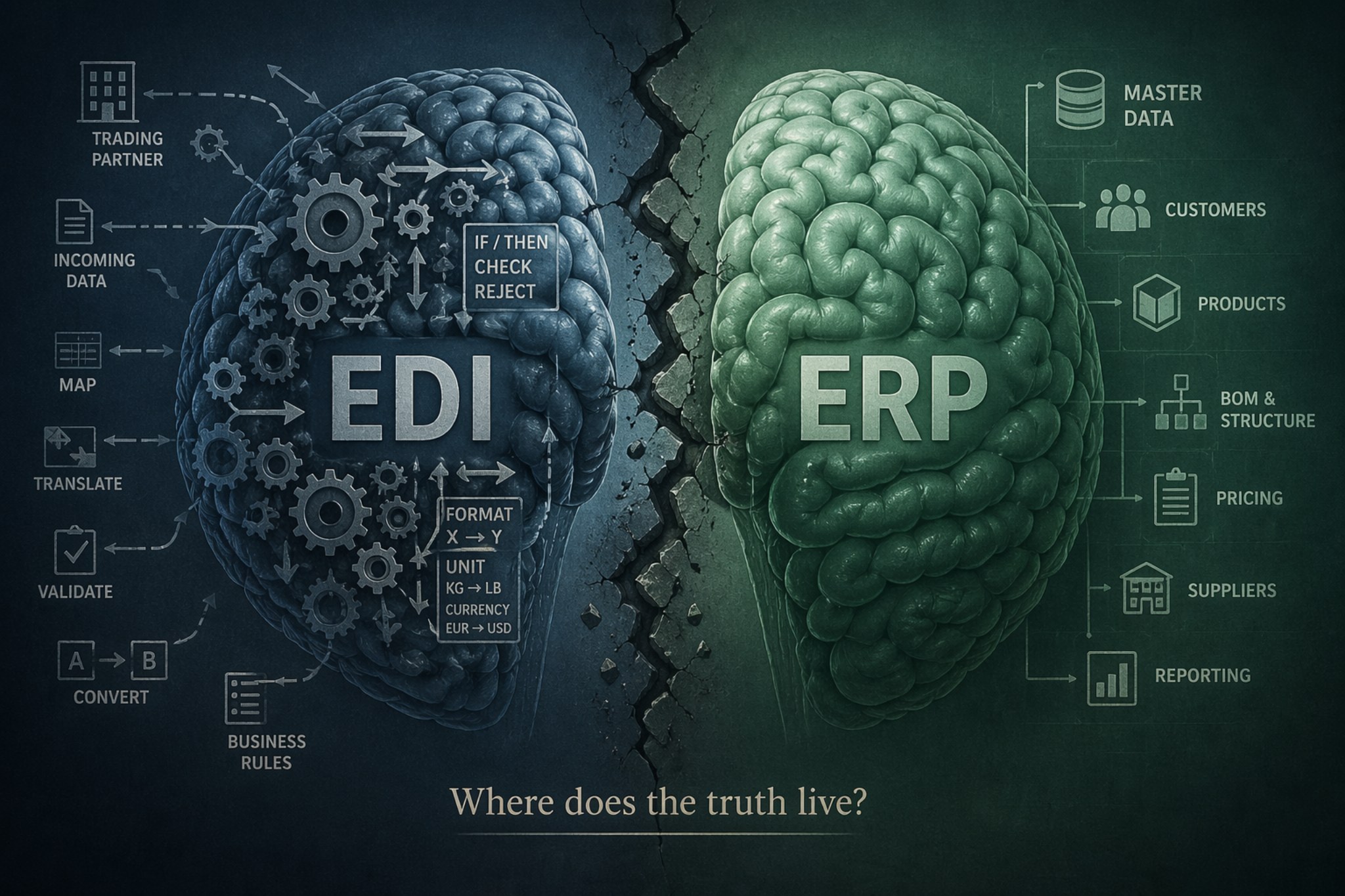
Single Source of Truth in EDI - Easier Said Than Done
How small EDI fixes like lookups, conversions, and custom rules can slowly pull business logic out of your ERP and create long-term complexity.