
Upgrading S/4HANA from 1909 to 2023: Lessons Learned
March 18, 2025 | by Rick Kromkamp

S/4HANA Upgrade: Lessons Learned
Upgrading SAP S/4HANA to release 2023 (particularly when moving from several releases prior) is a complex process that requires careful planning, resource allocation, and thorough testing. Based on our experience, here are some key lessons learned to ensure a successful upgrade.
Planning
Mock Cut-Over & Upgrade: Schedule a mock cut-over and mock upgrade in the target environment for NP1. This helps refine timing, uncover potential issues, and validate the upgrade process.
Testing in Mock Environment: Perform rigorous testing of RF transaction codes and ME activities, including product costing, in the mock environment with the latest data to identify potential upgrade challenges.
Resourcing
Ensure that in addition to SAP Basis, ABAP, and functional teams, you also involve:
EDI specialists to handle integrations.
Security experts to address role adjustments.
Infrastructure teams to prepare for system and hardware impacts.
Pre-Upgrade Activities
ATC Checks: Run ATC (ABAP Test Cockpit) custom code checks, specific to the target release, at least two months before implementation. Review all recommendations carefully and add pseudo-comments if needed.
Deleted Objects: SAP may remove objects considered obsolete, including custom objects within the SAP namespace. Before the upgrade:
Identify all custom objects in TADIR where the original system is SAP.
Modify the original system value to prevent unintended deletions.
This is particularly crucial for third-party add-ons with custom namespaces.
During the Upgrade
XLCA Step Execution:
Security & Role Changes: SAP modifies roles, including custom ones, during the upgrade. Ensure significant security team involvement to:
Review changes.
Adjust roles as necessary.
Reactivate custom roles to maintain system integrity.
SDM Monitoring:
After the Software Update Manager (SUM) phase completes:Check SDM_MON to confirm all tasks have been successfully executed.
If pending tasks exist, ensure the SDM process is scheduled to run and monitor its completion.
Testing Considerations
Month-End Close in UAT: Require all business units to conduct a full month-end close during User Acceptance Testing (UAT), including product costing validation.
RF Transactions Testing: Confirm that all RF (Radio Frequency) transactions function properly post-upgrade to avoid disruptions in warehouse and logistics operations.
Cut-Over Planning
Increase Disk Space: Ensure additional disk space is available on the production server to accommodate the database logs generated during the upgrade.
Database Log Handling: Consider turning off database incremental logs, as the upgrade process results in massive data updates that can quickly consume available storage.
Final Thoughts
The upgrade from SAP S/4HANA 1909 to 2023 is a major undertaking that requires detailed planning, proactive issue resolution, and a dedicated team across multiple functions. By applying these lessons learned, organizations can reduce risk, minimize downtime, and ensure a smoother transition to the latest S/4HANA release.
About the Author

Rick Kromkamp
Related Articles
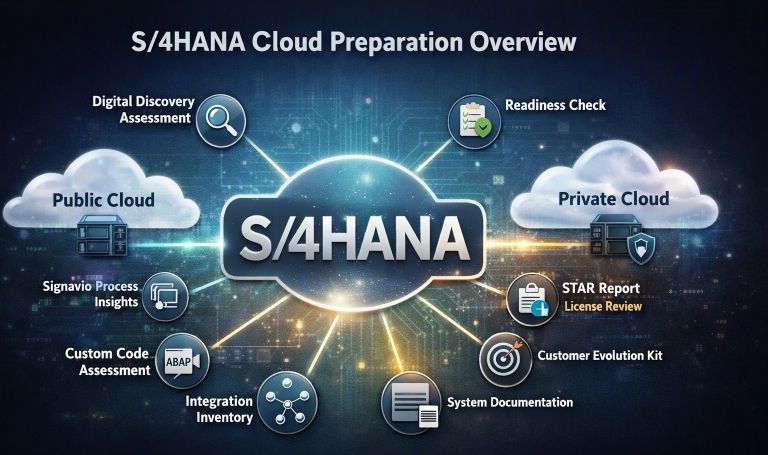
S/4HANA Public vs. Private Cloud — What ECC Customers Should Be Doing Now
A practical guide showing ECC customers the lowcost, highimpact steps they should begin now to ensure a smooth and wellprepared migration to S/4HANA Public or Private Cloud.
S/4HANA Public vs. Private Cloud — Understanding the True Cost Picture
The true cost dynamics of SAP S/4HANA Public vs. Private Cloud, and how subscription, implementation, and lifecycle factors shape longterm total cost of ownership.
S/4HANA Public vs. Private Cloud — Understanding the Fundamentals
A practical overview of the key differences between SAP S/4HANA Public Cloud and Private Cloud to help choose the right path forward.