
From Basic Accounting to ERP: A Strategic Guide to Growth
August 27, 2025 | by Michael Pearson
For growing businesses, software can quickly become a false friend—basic accounting tools may serve the early stages, but soon they become cumbersome and limiting. You may find yourself tangled in manual data entry, sluggish reporting, and multiple systems that produce fragmented insights. This is often a clear signal: it’s time to embrace a unified, advanced solution—Enterprise Resource Planning (ERP).
Here’s your roadmap: six strategic steps that’ll help you transition smoothly, minimize disruption, and position your business for sustained growth.
Step 1: Recognize the Need for Change
Ask yourself: Is your software holding you back? Persistent manual data entry, outdated reporting, lack of operational visibility, and scalability headaches are red flags. Having to log into separate systems for different entities? That’s a major clue that the time for change has arrived.
Step 2: Identify and Address Challenges Proactively
ERP implementation isn’t just a software project—it’s a change journey. Expect technical integration hurdles, budget overruns, and cultural resistance. Planning ahead brings clarity, helps you anticipate risks, and enables the creation of contingency plans that ease the transition.
Step 3: Build a Robust Change Management Strategy
Successful ERP implementations hinge on managing the People, Processes, and Plans. Align ERP capabilities with daily workflows, communicate clearly with stakeholders, and establish phased goals. A structured strategy helps build internal buy-in and organizational readiness.
Step 4: Prepare Your Team
Even the best software fails if people don’t use it. Invest in training, open dialogue about why the change matters, and nurture internal champions. These efforts foster enthusiasm, reduce anxiety, and drive adoption from day one.
Step 5: Execute with Purpose — Start Small, Learn Fast
Start with pilot testing—deploy the ERP to a small group, gather feedback, make improvements, and expand gradually. Ongoing monitoring during rollout ensures adjustments in real time and smoother scaling.
Step 6: Sustain Value Post-Implementation
Implementation isn’t the finish line. Measure ROI, reinforce the system’s value, and cultivate a culture of continuous improvement. Ongoing learning, regular performance reviews, and flexible workflow updates help your ERP evolve with your business.
Why ERP Matters: Beyond Accounting
ERP systems integrate core business functions—financials, CRM, manufacturing, supply chain, HR, project management, BI, and more—into a single framework.
For instance, Acumatica’s ERP brings together everything from multi-entity accounting to AI-powered dashboards on one cloud platform.
Blog Wrap-Up: Key Takeaways
| Challenge | ERP Advantage | |
|---|---|---|
| Manual data entry and siloed systems | => | Seamless integration and process automation |
| Poor visibility and lack of scalability | => | Real-time insights and future-ready infrastructure |
| Cultural resistance to change | => | Structured onboarding and internal champions |
| Post-launch stagnation | => | Continuous improvement drivers and ROI tracking |
Takeaway: Transitioning to an ERP isn’t a one-time switch—it’s a strategic evolution. With proactive planning and stakeholder engagement, you pave the way for long-term value.
Want More?
For a deeper dive into these six steps, including helpful templates and planning advice, check out Acumatica’s detailed eBook: Successfully Transitioning from Basic Accounting Software to an ERP System.
About the Author

Michael Pearson
Related Articles
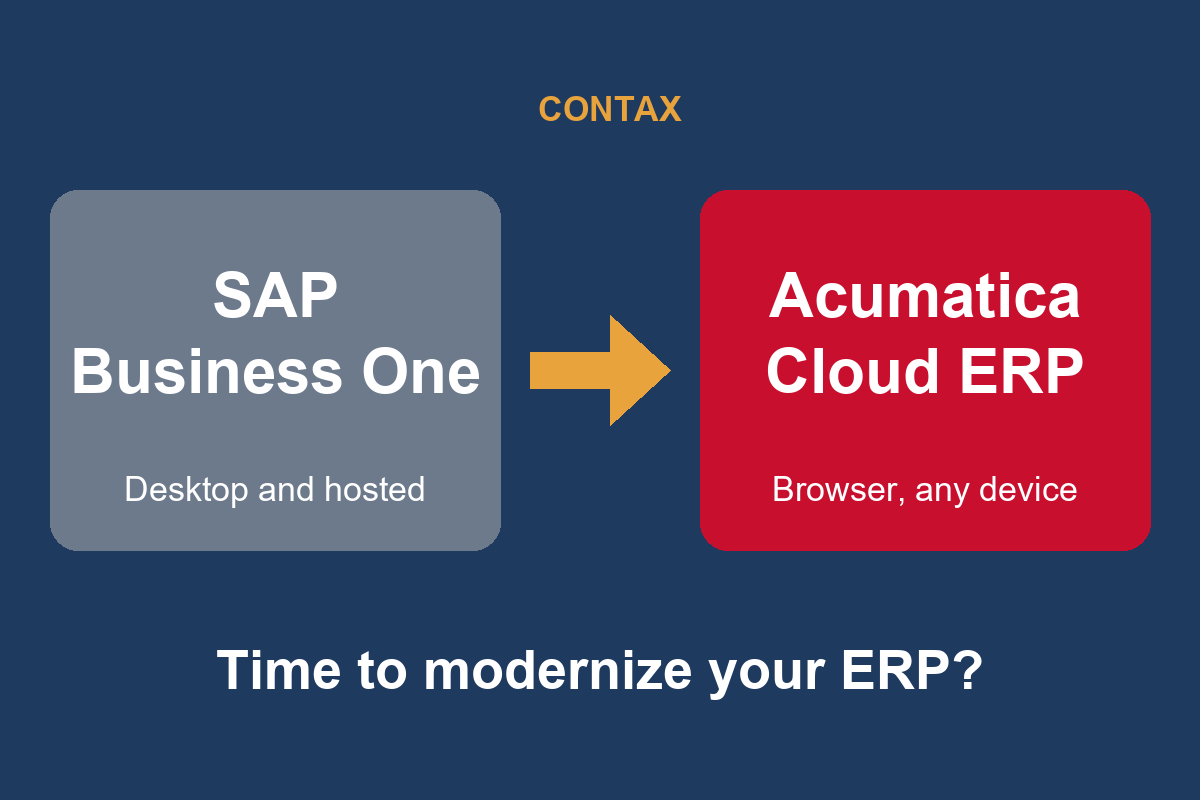
Why SAP Business One Customers Should Consider Moving to Acumatica
SAP Business One has served growing companies well for years. Here's why Acumatica Cloud ERP is worth a look as you plan your next ERP decision.

Wayne Safety Upgrades Operations and Warehouse with Acumatica and CONTAX
Wayne Safety replaced its 30-year-old DOS-based ERP with Acumatica Cloud ERP, implemented by CONTAX, and went live a month early with 35%+ better order management and a 5-day faster close.

LCG Foods Automates Retail EDI in Acumatica with Arcus
LCG Foods connected its Acumatica Cloud ERP to Farm Boy, Whole Foods Market, Sobeys, Nature's Emporium and Costco.ca with Arcus for Acumatica, fully managed cloud EDI from CONTAX.